Why a small hello matters
A postcard on a desk is a very small thing. Nobody writes a grant proposal for it. It won't fix a housing crisis or shorten a counselling waitlist.
We still think it matters — and not only because it's nice. It turns out that psychologists have spent years studying exactly this kind of small gesture, and what they keep finding is that we badly underestimate it. Here's the case, in four parts.
1. Most social steps are too big
If you're shy, socially anxious, or just tired, a lot of campus life asks for more than you have: go to the event, join the club, talk to the person next to you. The alternative is doing nothing, and "nothing" is lonely.
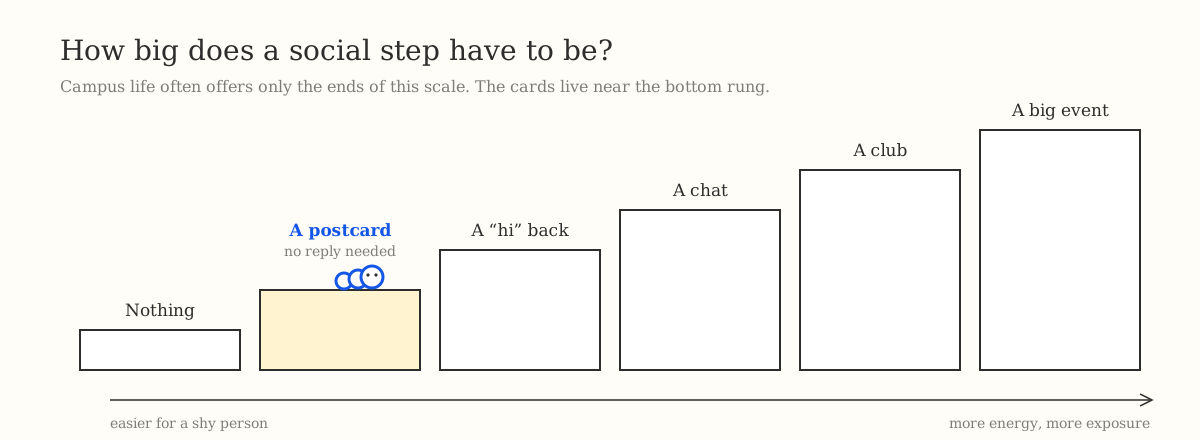
A postcard lives on the lowest real step. You don't have to be seen giving it. The person who finds it doesn't have to answer. Nobody performs. As the caterpillar put it in its essay for The Community Edition, connection can be small and still count. For someone who can't manage the bigger steps today, a smaller one is not a lesser one — it's the one that's available.
2. Kindness lands better than we think
In 2022, Amit Kumar and Nicholas Epley ran a series of studies on "random acts of kindness". In one, people handed out hot chocolate to strangers in a park and guessed how the recipients would feel. They guessed well below the truth.
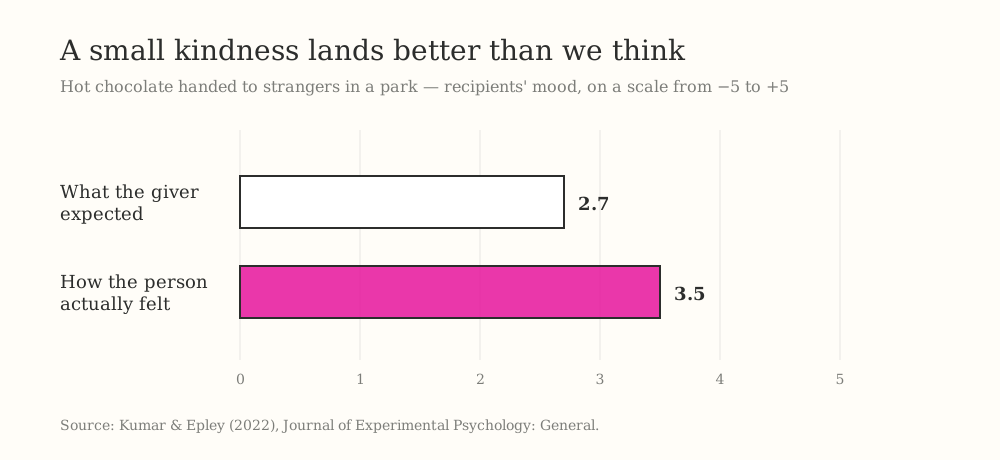
They found the same gap again and again: people who do something kind expect it to matter less than it does, and that's part of why we don't do it more often. The recipients in their studies were also a little more generous to others afterwards — kindness spreads. (ScienceDaily has a readable summary.)
That's more or less the whole theory of a postcard: the person leaving it can't see the moment someone finds it, so they'll always guess low.
3. Saying thank you isn't awkward (it just feels that way)
A few years earlier, the same researchers asked people to write short letters of gratitude. The writers expected their letters to feel awkward and to make only a small difference. The recipients, it turned out, were far happier, more surprised and less uncomfortable than the writers predicted — they didn't care about eloquence, only warmth (Kumar & Epley, Psychological Science, 2018; UChicago summary).
It's why one of our exercises walks you through writing a thank-you note. You don't have to send it. But you'll probably be surprised by how it feels if you do.
4. Strangers are nicer than we expect
In a study with commuters, Nicholas Epley and Juliana Schroeder asked some people to talk to a stranger on the train and others to keep to themselves. People expected the conversation to be unpleasant. It wasn't — the talkers had a nicer ride. We stay quiet partly because we misjudge how other people will receive us.
A postcard takes that fear out of the equation. It's a hello with the scary part removed.
Why it being anonymous helps
Two small design choices do a lot of the work here:
- No name, no debt. An anonymous card can't create an obligation. You don't have to thank anyone, reply or be grateful on cue. It's simply yours.
- Honest, not preachy. Every card starts by admitting that days can be hard, then offers a little light. "Just smile" can make a bad day feel worse; "everyone goes through hard things" makes it feel shared.
And when a card is made for a particular place — the Writing Centre, Counselling Services, a residence front desk — it also becomes a gentle signpost: help like this exists, and it's for you.
We didn't invent this
Leaving kind notes for strangers is an old idea with good company. Caitlin Boyle's Operation Beautiful filled public places with anonymous Post-its. Students in Newfoundland and Labrador covered lockers with encouraging notes in the #postitproject. The Random Acts of Kindness Foundation lists leaving a positive note as one of its everyday ideas. We're one more caterpillar in a long line.
What a postcard can't do
It's worth being clear: a card is a small hello, not care. If you're going through more than a bad day, please talk to a person — here's who you can reach, any time.
But for the ordinary hard days, the research lines up with what the caterpillar learned by doing: small gestures are worth more than they feel like they're worth, to the person who receives them and to the person who leaves them.
So if you've been thinking about leaving one of your own — here's how. It'll probably land better than you think.
People worth following if this interests you: Nicholas Epley (University of Chicago) and Juliana Schroeder (UC Berkeley) on why we misjudge other people; Amit Kumar (UT Austin) on gratitude and kindness; and Greater Good in Action from UC Berkeley for practices you can try today.
Say hi.
Loading…