Thank you for writing about us
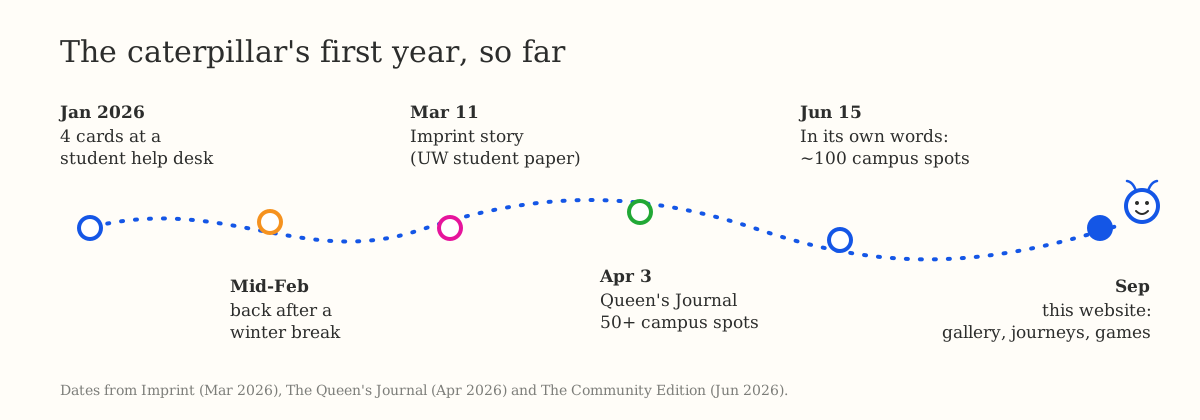
When you leave postcards on desks and counters for strangers, you don't expect anyone to write back. And then, this year, people did — in student newspapers, in a community magazine, and in a lot of little comments under weekly posts. This is our thank-you note, the long version.
It's also a chance to do something the caterpillar rarely gets to do: read about itself from the outside. Each piece noticed something different, and together they explain the project better than we could on our own.
Imprint: the person behind the cards
In March, Carla Stocco wrote the first story about the project for Imprint, the University of Waterloo's student newspaper.
It's the most personal of the pieces. Carla wrote about social anxiety and how hard speaking up can be, and about how poetry — especially erasure poetry, where you black out a page until something kinder is left — became a way of turning a heavy thought into a lighter one. She also described where the cards were going at the time: Counselling Services, the Career Centre, the Writing Centre, the Office of Research, and two offices that set up little displays so students could take a card.
What it shows well: that the cards didn't start as a campaign. They started as one person's way of coping, shared outward. That honesty matters. A kind note from someone who has also had hard days reads very differently from a slogan.
What it couldn't show yet: the other side of the card — the people who find one. A story about the maker is naturally about the maker. The project, though, only really happens in the second half: when a stranger picks the card up.
The Queen's Journal: the craft, and the idea travelling
In April, Marijka Vernooy wrote about the project for The Queen's Journal — from another campus entirely, which still makes us smile.
This piece is about how the cards are made. It describes two kinds of card: poetry cards, with longer poems and drawings, and art cards, made for a specific office and carrying only a few words. It names the poetry forms (erasure and concrete poems) and the influences you can spot in the doodles, from Studio Ghibli to Eric Carle. By then the cards had reached more than fifty places around campus.
What it shows well: that this is something anyone could do. The article ends on the hope that the idea travels — to Queen's, to libraries, to other schools — and on the belief that anyone can be an artist. That's exactly why this website has a Start your own page.
What we'd add: the art cards are quietly clever. A card made for the Writing Centre or Counselling Services isn't only decoration — it's a small, friendly signpost that says this place exists, and it's for you. For a shy student, finding the door is half the battle.
The Community Edition: in the caterpillar's own words
In June, the caterpillar wrote its own piece for The Community Edition's Queer Space section. It tells the origin story — four cards left at a student help desk in January, a pause over the winter, a return in mid-February after people asked for more — and by then, around a hundred places on campus had received cards: departments, residences, student associations.
The essay's central idea is the one we'd put on the front door if we could:
Social engagement can be small and still meaningful.
Campus life tends to offer two options: a big event with lots of people, or staying home. The postcards are a third option in between — a tiny interaction that asks for nothing back. The essay also explains the name: caterpillars are growing, imperfect, still-changing creatures. So are most of us.
r/uwaterloo: the place where people say hi back
And then there's r/uwaterloo, where the caterpillar posts new cards and where — after a short break — it came back to say hi again. A subreddit isn't a newspaper, but for a project about small hellos, a comment under a post is exactly the right size of reply. Thank you to everyone who left one.
Three stories, one caterpillar
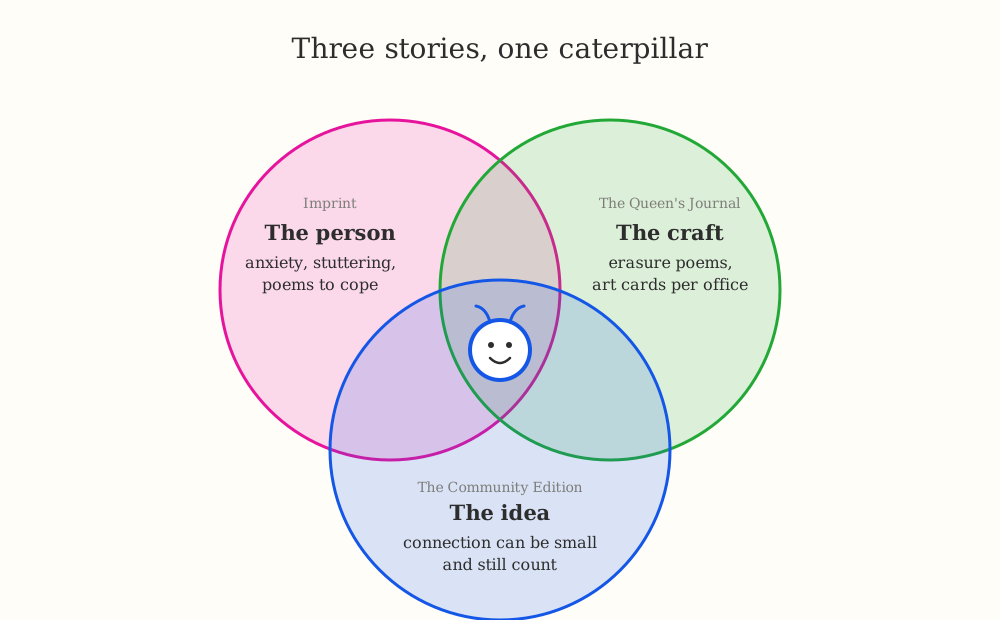
Read together, the pieces cover three sides of the same thing: the person (why it started), the craft (how it's made) and the idea (why it works). What none of them could capture yet — because it's only starting now — is the journey of each card after it's left behind. That's what this website is for. Every card in the gallery has a Journey tab: if you found one, you can add where it turned up, and over time we'll see how far a single hello can travel.
Thank you
- Carla Stocco and Imprint, for being first, and for writing about anxiety with care.
- Marijka Vernooy and The Queen's Journal, for carrying the idea to another campus.
- The Community Edition, for giving the caterpillar space to tell its story in its own words.
- Everyone on r/uwaterloo who said hi back.
- Every office, desk and residence that kept a card out where someone could find it.
If you've written about the project — or found a card and have a story — we'd love to hear from you. Say hello, or follow along on Instagram.
Say hi.
Loading…